Showing posts with label mobility impairment. Show all posts

Wednesday, August 1, 2012

Amanda's First Surgery - Bilateral Heel Cord Lengthening

Heel Cord Release|Surgery|Special Needs|CP|MD
Bilateral heel cord lengthening was the first surgery Amanda had. Its sometimes called heel cord release or tenotomy. We live 1,000 miles from any family members so there was no one to help us through this emotionally difficult experience.  I was scared and felt very alone. I wasn't sure what to expect during the surgery or the recovery period afterward. The surgeons, who do this operation dozens of times each year, gave us only limited information about the process and recovery.

I tried to have a positive outlook on things that left me trembling. This is an excerpt from a  letter I wrote to our families in 2005 explaining the situation,

"Amanda is facing a tough summer.  In mid-April we brought her in for a routine check up and discovered that she has quite severe scoliosis (57 degree curvature). We decided to put her into a full body brace for the next several years. She doesn’t like the brace and we’re all having a hard time adjusting to the new routine... 

...During the same appointment we discovered that she needs to have both of her heel cords released surgically.  They are contributing to the deformity in her feet and reducing her ability to walk independently... 

Amanda’s leg surgery is scheduled for July 1.  It is a relatively uncomplicated procedure that should be completed in 1-2 hours.  It does require general anesthesia and due to some of her other issues she will need to be on oxygen afterward.  For the next 4-6 weeks she will have both legs in solid casts, unable to walk.  She will also be wearing her new glasses, her back brace and her eye patch.  Not a normal summer by any stretch of the imagination!"
2005 purple casts

Although this is a common procedure for children with special needs we had never considered surgery. Amanda had been in orthotics since she was a year old. She never owned a pair of sandals or dress shoes because they simply didn't fit over the big clunky braces. We had thought the braces would prevent her feet and legs from developing any serious problems. However, despite years in braces her Achilles tendons had tightened to the point where they were impacting her ability to balance and needed to be corrected.

The bilateral heel cord lengthening was a fairly quick procedure. In our case it wasn't combined with any other surgeries. We went into the hospital in the morning and were home by late afternoon. It took just over an hour for the surgeon to make the small incisions and cast her legs. 

She was in the recovery room in less than 2 hours. All we had to do was wait for her to wake up enough to have a few sips of clear liquid and we were on our way home. I was sort of panicked about taking her home - what if something went wrong?
To our surprise, Amanda was given "walking boots". She was up and walking the next day. We found that water shoes (the type you wear at the beach) worked better than the boots supplied by the hospital. She used a walker for support, but she wasn't a very good walker before the surgery, so that was no surprise.

Amanda is nonverbal and seems to have a high tolerance for pain so I can't comment on how painful the surgery was. We kept her on the prescribed muscle relaxer and pain medication for the first few days and then tapered her off. I do know that after a few days she gave no signs of being uncomfortable.

The casts were heavy and awkward so she couldn't walk far in them. We already owned an adult stroller and used it to get her around. I know of parents who have had to rent wheelchairs for their children while they were in casts.

When the casts came off six weeks later, she had a tiny horizontal scar on the back of each calf. It was strange to see such a small incision when she'd had casts covering her entire lower leg, from just below her knee to her toes.

2009 blue casts
At the time I was terrified. I think any time your child is going to have surgery it's frightening. Amanda has had multiple surgeries and I know now that she will come through them fine. Still, every time they wheel her away from me on a gurney I get tears in my eyes. I hate thinking about my baby, unconscious and being operated on.

Four years later Amanda had a repeat heel cord lengthening, again despite wearing ankle-foot-orthotics (AFOs) for the years between the surgeries. Amanda's feet had become deformed over the years, from walking on her navicular bones. She was supposed to have a surgery called calcaneus extension. However, the surgeons determined that her bone quality wasn't good enough for that. They estimated that the donor bone would be approximately 10X stonger than her own bone. Instead they did  a second bilateral heel cord lengthening and casting. The second time they cut through more levels of the tendon with the hope of improving her gait.
First day of school 2009 -
 if you look you can just see the cast on her left leg.

The second time around was easier than the first. Even with the modified surgery it was day surgery. We knew what to expect this time and there were no surprises. Amanda came home in casts. We were all happy to sleep in our own beds that night, knowing that in  a few days Amanda would be feeling better and walking again. In fact, later that summer we took her on a family vacation to New England. She started back to school on time that fall, despite the double casts.

If your child or family member is facing this surgery I want to put your fears to rest. Aa Amanda has had this surgery twice I can honestly say that it was not a big deal.

Tuesday, June 26, 2012

Preparing Your Home for a Home Health Care Provider

How To|Prepare Your Home|Home Health Aide|CNA

Preparing Your Home for a  Home Health Care Provider

When you decide to employ a home health aide there are a number of changes that you need to consider - both in your home and in your lifestyle. What will it be like having another person in your home for hours or even days at a time? If you are a private person it may feel like an invasion. On the other hand, for some folks its welcome companionship - someone they can rely on to visit  daily.

You need to make your home as safe as possible for both your family member and their caregiver. Remove objects that may be easily broken. Prevent tripping by removing small rugs, runners, electrical and phone cords from pathways. Place non-skid adhesive strips to non-carpeted stairs. Make sure that your home is well lit - especially stairs and hallways.

You may need to purchase items that you don't already have. Things you should have include, but aren't limited to:
  • smoke detectors
  • carbon monoxide detector
  • nonslip bath rugs
  • nonslip stickers or mat in the bathtub or shower
  • grab bars by the toilet and in the shower/tub
  • flame resistant potholders
  • fire extinguisher

Having help when you have a family member with a disability can be a blessing. Another set of hands to help with care giving and household tasks can seem like a dream come true at first.

However, anyone who has employed a home care worker knows that the honeymoon period wears off.  My initial reaction was to treat the person like a member of the family while they were in our home.  I did this in part because I saw my parents struggle with the aides who cared from my mother.

My parents were very private people. They were brought up in a different era. The combination of these factors meant that they didn't want their live in aide dining with them. There was one fundamental problem with this idea- they only had one table. There was no where to sit and eat in the kitchen. Those poor women had to stand in the kitchen to eat their meals.

My parents wanted their aide to be "on call" but essentially out of sight. That meant that they were relegated to spending large parts of the day in their room or on the back deck, waiting for my parents to page them. Being a home health aide is a difficult, physically demanding job. The pay is poor and there are often no benefits. Adding social isolation must have made the job so much harder.

My mother was a little confused toward the end and some of her aides took advantage of her. While I was visiting one afternoon I saw her "tip" the aide five dollars three times for filing her nails that day. After my mom passed way small pieces of jewelry and other items were missing. I think that if my parents had been even a little more tolerant these small abuses might never have occurred.

On the other hand, I've learned that without some boundaries people may also take advantage of your good-nature. My daughter's aide is generally included in everything we do. She eats with us, hangs out in the living room and watches TV with us, etc .

In the past I've been so casual that people forgot they worked for us. Some have wanted to watch graphic crimes dramas with my daughter in the room. I didn't realize that one woman was using my laptop for online shopping until I went to several websites and the "Your Store" zip was set to her town. We've had aides show up with their children and their dogs.  One showed up before a job interview so she could use our shower!

In addition to making sure your aide knows what you want done, be clear about what NOT to do as well. While I don't want to create a feeling of distrust I do want to maintain a semblance of privacy in my home.  Some of these suggestions may make you feel ridiculous, but consider the alternatives. Be specific about any areas that are for family-only. I would rather hang a sign on my door than find someone up to their elbows in my underwear drawer. Let the person know if they are welcome to watch your TV (and what shows you would prefer they not watch), use your computer, etc. Here are a few tips based on my experience:

  • If you don't want your aide to pry into your bedroom, master bathroom or office, you need to clearly post a "PRIVATE" sign on the door.
  • Password protect your computers and cell phones. Lock file cabinets. Consider blocking unwanted content on your TV.
  • Label dresser drawers, kitchen cabinets, etc. to prevent "I was just looking for..." If everyone knows where to find necessary items there is no reason to look elsewhere. Most people will respect your privacy, but there is always one person that wants to go through your pantry or medicine cabinet.
  • If you have cherished heirlooms or valuables, move them out of sight or store them safely somewhere else. A spilled drink can accidentally ruin an antique table that looks "second hand"to an aide.

Be sure to interview any person or agency carefully before you hire them!


For more information on home safety for the elderly or individuals with special needs please go to http://www.ces.ncsu.edu/depts/fcs/pdfs/FCS-461.pdf

How to Write Instructions for your Home Health Aide

HOW To|Write Instructions|Home Health Aide|CNA

Home Health Aide Daily Care Plan & Instructions


When we first had a home health aide for my daughter the job seemed obvious to me. Not so to the various care workers who were assigned to her. Truthfully a home health care aide or companion typically has very little to do. A live-in aide can retire to his/her room and read or watch TV until you need their help. A part-time aide is in an awkward position because there isn't much to fill the time. I don't mind if the aides read, text or use their laptops - provided they meet my daughter's basic needs in a timely manner.

Do your homework when you hire an aide. It turns out that most people will only do exactly what is asked of them - no more, no less. For instance, with an elderly parent if you ask the caregiver to make a pot of coffee it is very possible that they will only make coffee on the day that you make that request. If your parent wants a pot of coffee made every morning with breakfast that needs to be specified. You need to prepare your home when you have someone working in it so they can find the things they need.

Review the instructions on equipment and procedures. Make sure that the aide has the written instructions available for any unique equipment like a lift. WATCH them perform complex tasks at least once to make sure that they are being thorough and safe. Don't trust that "showering" means the same thing to everyone. Some people may spray your family member down quickly, others may sit them in the shower and walk away for 10 minutes. Be specific about your expectations.

Review and provide instructions for all medications that the patient requires. Don't forget non-routine medications. For instance, if the person has an Epi Pen make sure the aide knows where it is and how to use it.

If you expect the person to prepare meals or snacks, make sure that they know where the ingredients are as well as what food preferences or allergies the person may have. When in doubt, provide a printed recipe including the location of all ingredients. Decide if the person will be eating with your family member and provide adequate quantities of food (obviously live-ins expect meals).

While it seemed ridiculous at first, I learned to provide a detailed list of each task that I wanted done every day.  Each task is described including the timing (after school, at dinner),  tools to be used (special cup, broom, etc.)  and the frequency (daily, weekly, etc.). I also include check boxes so the person can keep track of what has been completed each day.

The last section of my daily list includes safety instructions. Make sure that you have your address written down in the event of an emergency. You'd be amazed at how many people simply follow their GPS and have no idea where they are. If you are not going to be there at all times include your contact information on this page as well.

Here is an example of a daily care plan for a 4-hour after school shift for our daughter. Your plan may be more detailed depending on medical needs and the extent of home care tasks you expect.


Daily Home Care Plan for __________________      Date:  _____________

Tasks include, but are not limited to:
Personal Care

         Meet & get her off school bus using wheelchair

         Change clothing if wet or dirty immediately after school

         Toilet or/change Depends every 2 hours   

o   Completed  at     time _____________       time _____________   

o    Check  Depends immediately after school. Change after shower & before bed

o   Thrown wet/dirty Depend in kitchen trash can

         Provide afternoon snack (prepared in frig) Complete at time _____________   

         Assist with ambulation around house (maintain contact guard at all times)

         Assist with TV remote, computer, etc.

         Shower daily    Completed at time _____________   

         Brush hair daily after shower

         Wash hair on Wednesdays   Completed date _____________   

         Assist with feeding during meals & snacks

o   Cut food into bite sized pieces for finger feeding

o   Assist with use of spoon or fork (may need to feed her)

o   Place dirty dishes, cups and utensils in the sink

         Provide companionship & supervision at all times
     Maintain safe environment while parents are away or otherwise occupied.

Home Care

         Make bed daily    Completed at time _____________   

         Fold & put away laundry as needed (2-3 times a week)

         Dust & vacuum bedroom on Mondays (weekly)  Date _____________   

o   Use Swiffer dusters and Shark carpet sweeper

         Clean bathroom on Fridays (weekly)    Date _____________   

o   Use disinfecting wipes to wipe down toilet & bathtub

o   Lift no slip mat and place on shower chair to air dry

Safety    I can be reached at 555-555-1234

Never allow her to walk around the house alone – be with her at all times.

Watch for choking while eating and drinking.

In the event of a clonic/tonic seizure (grand mal):

1.    Ensure her safety - roll her to her side, if possible

2.    Call 911 The address here is 123 Main Street Anywhere,ST

3.    Administer medication per instructions on label (outer pocket of blue backpack)
For insights on the aide's perspective please go to http://newoldage.blogs.nytimes.com/2009/01/21/advice-from-a-home-health-aide/

Friday, June 1, 2012

Walt Disney World with a Wheelchair - Part 5 Rides

Walt Disney World|Wheelchair Access|Rides

Walt Disney World with a Wheelchair

Getting on the Attractions (Rides)
Disney attractions fall into several categories when you're in a wheelchair: those you can stay in your chair for, those you must be in or transfer to a manual wheelchair for and those you must be able to transfer into a regular seat. In some cases you may need to transfer from your ECV to a manual wheelchair. And in some instances it may just prove impossible to access an Attraction. Cast Members are not permitted to assist with transfers, so if you can't transfer independently or with the aid of a member of your party, you'll need to skip that ride. It's a little complicated, to say the least. Before heading to the Parks you can search the Attractions at Walt Disney World Resort web site by entry requirements (i.e., "Wheelchair and ECV accessible".)
There is a wheelchair accessible Swan on the Carousel
There are 138 Attractions (rides) in the Walt Disney World Resort. Disney categorizes rides ranging from "Must be Ambulatory" to "Wheelchair and ECV Accessible" - and a number of transfer options in between. If you can't transfer comfortably you will need to do some advance planning to see what you can and cannot do at each park. You can check accessibility on the Disney website or you can download the Accessibility Guide for each park.

The percentage of fully accessible rides is truly amazing! There are only three Attractions that fall into the "Must be Ambulatory" category (all in the Magic Kingdom):
  • Tom Sawyer Island
  • Tomorrowland Transit Authority
  • Swiss Family Treehouse
I know of four rides (although there may be more) where you must transfer onto the regular attraction seat. These are:
  • Maelstorm
  • Mission: Space
  • Soarin'
  • Spaceship Earth
That means that roughly 95% of the Attractions are fully accessible! Remember that in Disney-ese Attractions include the shows, parades, etc. - not just rides.  All of the various shows have wheelchair access. You will be typically be asked to park in the back row to avoid obstructing others' views, but the view is still good.
There is a wheelchair boat on Its a Small World

You can definitely get on most of the rides. You may have to wait for a wheelchair accessible boat or car. Rides that I know have wheelchair boats include Its a Small World and the Jungle Cruise in the Magic Kingdom. Newer rides actually have pieces that can be swapped out to accommodate an ECV or wheelchair. The first time I saw this was on ToyStory Mania. It was pretty impressive to watch the Cast members remove part of the ride and swap in another section.
Step in to seat on Dumbo

If you are in an ECV you may have to transfer to a manual wheelchair for some rides. Disney Cast Members are typically very good at politely asking if you can transfer. Waiting for a special vehicle may take a while, but transferring directly to the ride can be harder than you might imagine. It's rarely a simple step into a ride on the same level. Some of the rides have multiple steps up or down (Jungle Cruise). Others have awkward or dark space that you need to step into like Dumbo or Magic Carpets of Aladdin.
Step down into Jungle Cruise boat
Disney Cast Members aren't allowed to help with transfers. This is intended to protect your privacy. Therefore you need to travel with someone who can help you make these transfers if you can't walk independently.
We always help our daughter but as she gets bigger some of the rides become harder to access. We actually had very good luck transferring her on a seat for Spaceship Earth as the loading area is sort of a moving sidewalk that moves with the cars. We were able to push her chair right onto the ramp and help her in at her pace. On the other hand, Magic Carpets of Aladdin at night (in the dark) was nearly impossible.
Remember Disney isn't all about the rides! There are wonderful shows, parades, fireworks and dining experiences that are all accessible. Even if you avoid the traditional rides entirely you can still have a great time at Walt Disney World.

Walt Disney World with A Wheelchair Part 4 Dining

Walt Disney World|Wheelchair|Dining

Disney Dining When You're in a Wheelchair


Table Service Restaurants
Dining can sometimes be a challenge if you don't plan ahead. Many Disney restaurants are crowded and hard to maneuver with a wheelchair - particularly Character Meals where everyone is moving around more than normal. For instance our daughter once was asked to transfer into a regular chair at Akershus during the Princess breakfast. Her wheelchair was safely stored and returned to us at the end of the meal.


Also, due to the need for extra space you may not get the prime views that the restaurant is famed for. If you want a good seat or the view the restaurant is known for make sure to ask for it before you are seated! Otherwise you will most likely be stuck out of the way.

Don't count on there being room for a wheelchair in a table service restaurant if you try to walk in! When you can, make advance dining reservations and be sure to specify that you will have a Guest in a wheelchair dining with you. Hopefully if Cast Members know about your needs ahead of time that they won't try to seat your party in a booth or a hard to reach corner.


You can (and should) make reservations for Character Dining, Dinner Shows and Signature Dining. If you've used a travel agent to plan your trip they can also give you insights on restaurants and make your dining reservations for you. The service is free!

You can call 407-WDW-DINE yourself for reservations if you want. Cast members are always happy to help you with reservations. However, its just as easy to create your own reservations online.

After you chose your restaurant and time you will get a screen labeled "Guest Information". This will include the restaurant, time, number in your party, etc. You will need to fill in a phone number that you can be reached at while on vacation. Next - and most importantly!- click on the box to the left of where it says "I have special requests or a food allergy."


Once you have checked that box, another window will open allowing you to specify any common food allergies as well as the fact that you will be need wheelchair accessibility. Not only do we request wheelchair access, we have two food allergies to contend with so I always start here. If I have any other special requests I can follow up with a call to WDW-DINE. Don't be afraid to try booking your own dining reservations on line. It's easy!

We tend to eat light so we only have one or two table services meals per visit. We've eaten at Sanaa, Akershus, Nine Dragons, Cape May Cafe and Kona Cafe with no problems.

What about Quick & Counter Service restaurants?
There are lots of options when it comes to dining at Walt Disney World. How do you handle the places where you can't make a reservation? If you are on the standard dining plan chances you have one quick service meal, one snack and one table service meal per person per night. If you are paying for your meals out of pocket, you probably still don't want to make every meal a table service meal.

Not all Quick service restaurants are equal when it comes to wheelchair accessibility. Some counter-service locations have narrow lines delineated with rails that aren't wide enough for a wheelchair. You will need to send someone for food or contact a host or hostess for assistance. Our typical strategy is to send one person to place the orders, pay and carry the food as some of the places we're tried can't accomodate even a manual wheelchair.
Focaccio Sandwich at Starring Rolls - great if you can make it through the chair maze!

For instance, Starring Rolls Bakery in Hollywood Studios has great sandwiches, but the area is a little corner, which you have to navigate a series of tables and heavy metal chairs to get to. It's a lot of work but worth it for delectable bakery goods. An easier choice in the Backlot Express which is crowded, but roomy enough to navigate without much problem. The hardest part will be finding a free table!

In the Magic Kingdom Cosmic Ray's has a lot of seating, but railings separating the lines so again you will probably have to ask someone else to order. Casey's Corner has good food & a few outdoor tables, but the indoor seating is bleachers (super cute sports theme) so not accessible. We all love the Kiddee Cones at Plaza Ice Cream Parlour but it has such a narrow line that it won't accommodate a wheelchair. One of us waits in line and orders the cones while everyone else waits outside


An easier place to get ice cream at the Magic Kingdom is Storybook Treats. It is an outside location with a small covered waiting area. They have yummy soft serve cones, sundaes and shakes.


At EPCOT in Future World we tend to go for the Electric Umbrella as it is quick; however the lines are impossible with a wheelchair. You'll need to split up to place your order. our We've also eaten at Sunshine Seasons. It can be very crowded! Its cafeteria style so again, its a good idea to leave the person in a wheelchair gaurding your table while some one else picks up the food. A great option is to try the various snack carts around the World Showcase. You can order food and find a shady spot under a tree or by the lake to eat.

I can't say that we've eaten at every Quick/Counter Service restaurant or snack cart. I wish I could give you a detailed list of your best choice when it comes to accessible casual dining, but it's nearly impossible. So much depends on the size of your wheelchair or ECV, whether you are traveling alone or with companions, your own food preferences...
For a complete list of Quick Service Restaurants, go to the Walt Disney World website. All I can say is that if you want to eat somewhere and find that you can't access it with your wheelchair, flag down the nearest Cast Member and politely explain the problem. Most Cast Members will be happy to help in anyway they can - from getting the host or hostess for you or even carrying your meal if you can't. Just be nice and ask - you might be amazed by the magical response!

Walt Disney World with A Wheelchair Part 2 Getting Around

Walt Disney World|Accessible Transportation

Walt Disney World with A Wheelchair

You're At WDW - Now what?

Getting Around the Parks
Disney does a lot of things right when it comes to accessibility. They have ample disability parking. They provide ramps into all forms of transportation from the boats at EPCOT to the trains at the Magic Kingdom. There are lifts on the buses. There are companion bathrooms.

Much of the Magic Kingdom and EPCOT were built before the Americans with Disabilities Act. Navigating Walt Disney World pushing a stroller is tricky. Navigating pushing a wheelchair is even harder. The streets and pathways are crowded. The lines are long. It's hot. Disney has ramps into almost every ride and restaurant, but there are still steep ramps, hills and long distances to contend with as well as the crowds.


Don't try to push a wheelchair down the center of Main Street in The Magic Kingdom - stay on the sidewalks or travel through the shops. There are a series of grooves in the pavement intended for the various Main Street Vehicles that will catch your wheels. Also, The Magic Kingdom has very few curb cuts - and they aren't painted white - so you may have to bump over a curb. The Cast will wave glow sticks if you're about to crash off a curb during a night parade. In all of the Parks Guests may block curb cuts-especially around parade times!- not realizing that you have no other way on or off the sidewalk.

What is a Guest Assistance Pass?


Once you have a way to get around the next thing you will need is a Guest Access Card (GAC). If you are in a wheelchair the Cast Members are supposed to help you find an alternate entrance to rides, etc. and you don't necessarily need to get a GAC.

In our experience its best to take the few minutes at the beginning of your first day to stop by Guest Relations and get a Guest Access Card (GAC), particularly if you are using a non-standard wheelchair like a Convaid or other adult stroller. Guest Relations will provide you with an GAC as well as a tag for your Convaid that says "May Use Stroller as Wheelchair." You only need to get the GAC once - its good at every park for the length of your visit or for up to three months with an Annual Pass. The card is valid for the holder and up to five companions.

Notice the red sticker on her Convaid stroller
The Guest Assistance Pass is typically an alternate entrance pass. On many rides you will wait in the same line as any other Guest - the only difference being that when you get to the end you will enter through a gate rather than a turnstile (just like at the entrance to the Parks.) For instance if you don't have a FastPass for Toy Story Mania you will be sent to the StandyBy Line - at the end there is a gate to accommodate a wheelchair. At many popular Attractions such as Dumbo, Aladdin and Disney Junior Live on Stage you'll wait in the regular queue; there is no alternate access.

On other rides the alternate entrance will bring you to a separate loading area. This is the case at Spaceship Earth. If you enter through a separate entrance, a number of people from the regular line will board the ride, then a few from the alternate access line will be allowed on, in repeating sequence. A GAC will not necessarily get you on to the rides any faster. Your best best is to split up into small parties of two as they place those faster than larger groups on popular rides, regardless of which entrance you use.

Tell Guest Relations if you or your child can’t wait in line for medical reasons (heart condition, autism, etc). They may be able to provide you with a pass that will provide other accommodations such as allowing you to wait in a separate area.

Alternate Access line at Spaceship Earth - about 60 people ahead of us
When you can - use a FASTPASS! (If you aren't sure how to use your Fastpass, please follow the link.) A GAC is not a replacement for a Fastpass. Go ahead and get your Fastpass for the ride or attraction and return at the stated time. You will be escorted to the alternate entrance and admitted.

Also, be prepared to hear some grumbling from other Guests who think you are getting special privileges using your GAC. We've occasionally heard some ugly comments from other Guests. Try to remember that everyone is hot and many people are impatient. If they see you entering through another door they naturally think you are getting ahead of them in line.

There are amazing shows, parades, tours and special experiences you can enjoy that don't have any kind of barrier to entry - try to see Dream Along with Mickey in the Magic Kingdom! It's performed on an elevated stage in front of Cinderella Castle and everyone has equal access to "good spots."

Walt Disney World with a Wheelchair Part 1

Flying|WheelchairWalt Disney World

Walt Disney World with a Wheelchair

So, You're Thinking of Going to the Walt Disney World With a Wheelchair?

Great! Go for it! I have only been to Walt Disney World once without a wheelchair. My oldest is mobility impaired. That means that she doesn't walk - she's my little diva on wheels. Being in a wheelchair can't keep her away from Disney World! And it shouldn't. Disney is wonderful even if you're in a wheelchair.

Like any visitor to the Walt Disney World Resort, when you are traveling with someone with special needs the difference between an okay visit and a magical visit is planning. You can stumble along and have a nice time. However, the more you plan ahead, the better your experience will be. Planning starts with researching (good news, if you're reading this you're already researching!) and ends with packing. That way by the time the big day arrives you'll be ready to experience the magic!

If you will be going to to Disney World with some one with a mobility impairment the place to start is Disney's Guests with Mobility Disabilities. You will want to decide if you are going to bring your own wheelchair or rent one. You need to decide where you are going to stay and whether you need to request an accessible room. You'll also need to know which rides you can easily access and where you want to eat.

Getting There with A WheelChair
If you own a wheelchair you can bring it with you - even if you are flying. The Air Carrier Act law requires that at least one folding wheelchair per flight be accommodated in the cabin - even if means displacing the crew's or first class passengers items. This is the best way to ensure your wheelchair isn't lost or broken.

If there is already another wheelchair in the cabin, they will gate check the chair and take it down to be loaded in the baggage compartment. You need to make sure they know how to handle your wheelchair. We put any detachable parts in a carry-on duffel bag and tape a list of instructions & parts on the wheelchair. By law access equipment doesn't count toward the your carry on limit, so if you have to bag the parts, they have to stow them in an overhead or on board compartment.
Just follow the blue line!
Once you get to Walt Disney World there is generally ample disability parking at the Parks- if you arrive early in the day! We've arrived in the later afternoon/early evening only to find there are no spaces available. If you plan to leave the park for a meal at a resort or to park hop, try to leave your car in one location and use Disney transportation to move around.
Some people think that parking may be free if they have a handicap permit or plate. The same daily parking fee applies, regardless of your permit. After you pay, follow the blue line to the accessible parking spaces. Remember to keep your receipt - its good for parking at any other Park that day. You can, however, use Valet Parking at any resort for free if you have a disability plate or placard- just don't forget to tip!

Every Park has a Disability parking area. If you didn't bring your own wheelchair, but will need to rent one or an Electric Convenience Vehicle (ECV) you can borrow a manual chair. These courtesy chairs are free. They need to be exchanged for a rental before you can enter the Park.

We are lucky enough to live within driving distance so I have no personal experience with Disney's Magical Express from the airport to your Disney Resort. All you have to do is reserve Disney's Magical Express Transportation by calling (407) WDW-MAGIC. The buses accommodate wheelchairs - just make sure to tell them you have a chair with you when you make your reservation!
Disney Transportation with a Wheelchair
Friendship Boat in EPCOT
Guests with mobility impairments can typically use the same free Disney transportation available to all Guests. We've never taken any of the buses, but they all have lifts that should accommodate a standard wheelchair. We have been able to access the ferry to the Magic Kingdom as well as the Friendship Boats in EPCOT without a problem. Use the Friendship Boats to shorten the distance are EPCOT - they cross the lake that separated Future World and the World Showcase.


Monorail


We've taken the monorail many times as well. When you get to the monorail loading platform wait in the area marked with a wheelchair symbol. A Cast Member will extend a ramp that allows you to roll onto the monorail. Don't be surprised if able bodied Guests cut you off and rush up the ramp ahead of you! Especially at the end of the day it seems that everyone is anxious to get on board the air conditioned monorail.

All of the Parks require a lot of walking (or pushing, riding, etc.) EPCOT has the Friendship Boats to shorten the trip between Worlds. Animal Kingdom has the Wildlife Express Train. Hollywood Studios is small enough that there isn't really any in-Park transportation. However, if you are at the Magic Kingdom by all means use the Walt Disney RailRoad to move between "lands". The first car of the trains is wheelchair accessible. You & one member of your party will be allowed in the first car. The train stops at the Entrance, Frontierland and Fantasyland. It's a nice ride and much better than trying to negotiate through the crowds.

Walt Disney Railroad

Ferry to Magic Kingdom
Where to Stay When You're in a Wheelchair?
We consider the Ferryboat ride to the Magic Kingdom part of our ritual and truly enjoy every minute of it, but it does eat into valuable park time.

Hotels are required by the Americans with Disabilities law to have accessible rooms on the first floor. Rental houses are not required to provide accommodations. When we rent a house we have to bring a great deal of adaptive equipment to meet our daughter's basic needs even in a single story house. You may find that you are more comfortable and safer in a hotel than a rental property.

Renting a Wheelchair or ECV
If you didn't bring your own wheelchair you can rent wheelchairs and Electric Convenience Vehicles (ECVs) at the entrances of all of the Theme Parks. You can find them with the stroller rentals.

There are no wheelchair rentals at the water parks. You may also be able to rent a manual wheelchair from your resort. If you rent a wheelchair from your resort a $315 refundable security deposit will be held against your room charge and returned when the chair is brought back. Wheelchairs and ECVs can be rented for longer periods through local Orlando businesses.
Wheelchair rental at EPCOT

When you rent a wheelchair or ECV at a Park you cannot take it to another Park, however if you hold onto your deposit receipt you can get one (if available) at another Park on the same day at no additional cost. The cost* for a manual wheelchair rental is currently $12 per day and $50 for an ECV rental. A security deposit is required for all ECVs, which will be returned when the ECV is returned. There is also a $100 refundable security deposit for either a manual wheelchair or an ECV rented at a Downtown Disney Location. (*2012 rates)

Wheelchair Backpack
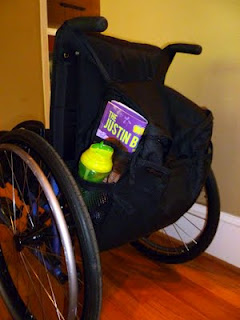
Wheelchair backpack
While any backpack can be hung off the handles of a manual wheelchair, I highly recommend that you purchase a special wheelchair backpack. We've had ours for several years and its been on planes, buses and cars without a worry. The top zipper broke after about a year, but I was able to easily repair it with stick on Velcro from the grocery store.
A wheelchair backpack is designed to fit between the wheels of a manual chair so you don't have to worry about bumps and rubs. Ours slips over the handles and has several convenient exterior pockets for us to stow a water bottle, sunscreen and other little items. I particularly like it because the outer pockets are mesh and easily visible. That means that the Cast Member at the Park entrance is be able to screen it fairly quickly.

Don't forget that in addition to the basic Disney necessities such as sunscreen and hand sanitizer, your party may require a few extra items including any special toileting items you may need. There are companion restrooms throughout the Parks. Remember to pack any necessary medications in your backpack as well. If you need to carry epi-pens, medications or special food, please inform the Security Cast Member at bag check that someone in the party has a medical condition. You will be allowed to bring these items into the Park. For instance we need to bring my daughter's seizure medication with us.
Cooling Pad
sign for First Aid Station

Another awesome wheelchair accessory is a personal wheelchair cooling pad. We chose one that uses phase change material technology. Ours came from CoolSport. It is the best thing we've ever bought to combat the heat. It kept our daughter comfortable even on a 100 degree day. It comes in blue or black. The interior CoolPacks are quickly charged after about 20 minutes in cold water or the refrigerator. The cells turn white after they have been "charged". The exterior cover remains dry. The cooling effect lasts for hours. The Cooling Pad cost about $60 and arrived within 4 days of ordering. Wonderful product - wonderful service! And so much better than risking heat stroke.

By the way, the Parks all have First Aid stations and they are more then willing to help you in an emergency. On our first visit within minutes of entering the Magic Kingdom as we were oohing and aahing at our first site of Cinderella Castle my oldest's eyes swelled almost completely shut. My husband ran to the nearest shop and the Cast Member not only directed us to the First Aid station, but sent someone to accompany us there so we didn't get lost. Only in Disney!

My basic message is simple, You can do this! Walt Disney World is better equipped than most places to handle whatever special needs you may have. The Cast Members will work with you before you get there to make sure that you have a magical time, whether it is getting the perfect dining reservation, getting to your Resort or around the Parks. Try some of my tips for making the most of magical service - you won't regret it.

Stay tuned for Part 2 - What Do To When You're There!